The Two-Sided Case for a Pilot in Supply Chain Orchestration
A pilot is not just a lower-risk way to buy orchestration technology. It is the start of a relationship that works better for both sides of the table.

Most of the conversation about pilots is written for the buyer. It makes sense: buying supply chain orchestration software is a big commitment, touching live shipments, existing systems, and the teams who run them every day. A structured trial on your own data is the obvious way to reduce that risk.
Moddule CEO Hans Elmegaard has made that case from the enterprise buyer's seat, covering the confidence gap in evaluating logistics technology and the benefits of a structured pilot.
Read more: Why a Pilot for Supply Chain Orchestration Technology Safeguards Your Investment
This article covers the other side of the same table. What does a pilot ask of the technology provider, why should a vendor want one, and how does that commitment end up working in the buyer's favor?
What a pilot asks of the vendor
A pilot is not free trial software with a sales rep attached. Done properly, it requires meaningful engineering dedicated to one customer's environment: connecting their data sources, mapping their trade lanes, and configuring the product around how their teams actually work.
That is a real cost for a technology provider, and it is a deliberate one. Enterprise engagements matter to a vendor, commercially and strategically. That stake is what justifies the level of engineering and account resourcing a serious pilot needs. When a vendor commits that resourcing to a trial, it is a signal that they expect the relationship to last, and that expectation shapes how much attention your deployment gets.
The question for buyers is simple: is the vendor treating the pilot as a sales step or as the first phase of a deployment? The answer tells you a lot about what the next three years will look like.
Why the vendor's commitment pays off for the buyer
It runs alongside your operations, not inside them: A well-structured pilot sits next to existing workflows rather than inserting itself into them. Teams keep running shipments the way they do today while the new system is tested in parallel. You get a true test of performance without taking on operational risk to run it.
Onboarding during the pilot pays off twice: The data connections, mappings, and working frameworks set up during the trial carry forward. If the pilot converts to a full deployment, that groundwork is already done, which means less friction and a faster path to value for both sides. Anything scoped in a follow-on engagement builds on a foundation both teams already trust.
Edge cases make the product sharper for everyone: Large, complex operations surface edge cases a smaller rollout never will. For the vendor, solving those problems early is worth more than any demo. For the buyer, it means the product is being shaped around the hardest version of their reality, not a simplified one.
Related: The 90-Day Path to Proof for AI Logistics Tech
Two confidence gaps, one trial
Buyers need confidence that a platform will perform on their data. Vendors need the same confidence, proven in the most demanding environments they serve. A pilot closes both gaps at once. It replaces a sales pitch with a shared project: both sides working to prove the same thing works, on the same data.
Inside an active pilot: getting the most accurate ETA possible
Ocean freight ETAs have a trust problem. Track the same container across different sources and you might get three or four different arrival dates. On lanes with heavy congestion, poor data, or frequent schedule changes, the gap between estimated time of arrival (ETA) and actual time of arrival (ATA) is exactly where safety stock piles up and demurrage and detention (D&D) charges get triggered.
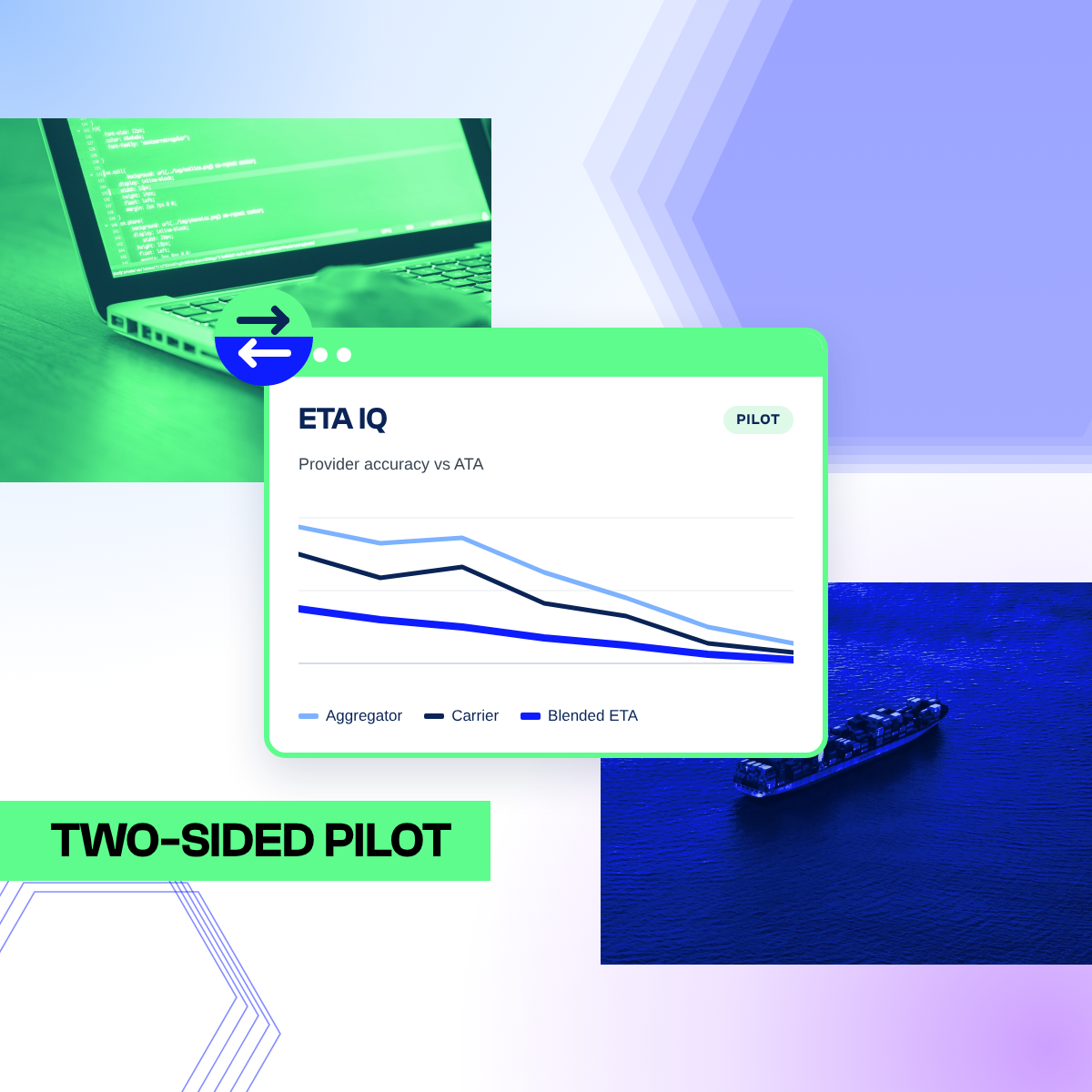
Most teams rely on one or two data sources and accept the blind spots that come with them. ETA IQ takes a different approach to predictive ETA. Rather than trusting a single source, it scores multiple providers against each other for every unique journey, weighting each one by how reliable it has historically been for that specific carrier, port, and lane.
It goes deeper than the lane. Our team is testing whether some sources are more accurate at the start of a journey, such as aggregators, while others perform better toward the end, such as the carriers themselves, and how well each source accounts for variables like weather. As new signals come in, the trust scores update live, so the blended ETA draws on whichever source is proving most accurate at each stage of the journey.
ETA IQ is currently in pilot with two global fashion retailers, validated against their own ocean freight data. The dashboard above shows how we track provider accuracy against actual arrival, days out from ATA. It is exactly the kind of granular, on-their-data view a pilot is built to produce, and the kind of evidence neither side could get from a demo.
You Might Also Like: Why Accurate ETAs Are Critical for Ocean Freight
Proof first, then scale
A pilot is not a hurdle between you and orchestration technology. It is the fastest, lowest-risk way to get there, and it works best when both sides have something real at stake. Look for a vendor who treats the trial as the first phase of a partnership, not the last step of a sale.