Prove ROI Within Three Months of Implementation
A clear breakdown of what a 90-day pilot for AI-powered logistics tech looks like, milestone by milestone.
.png)
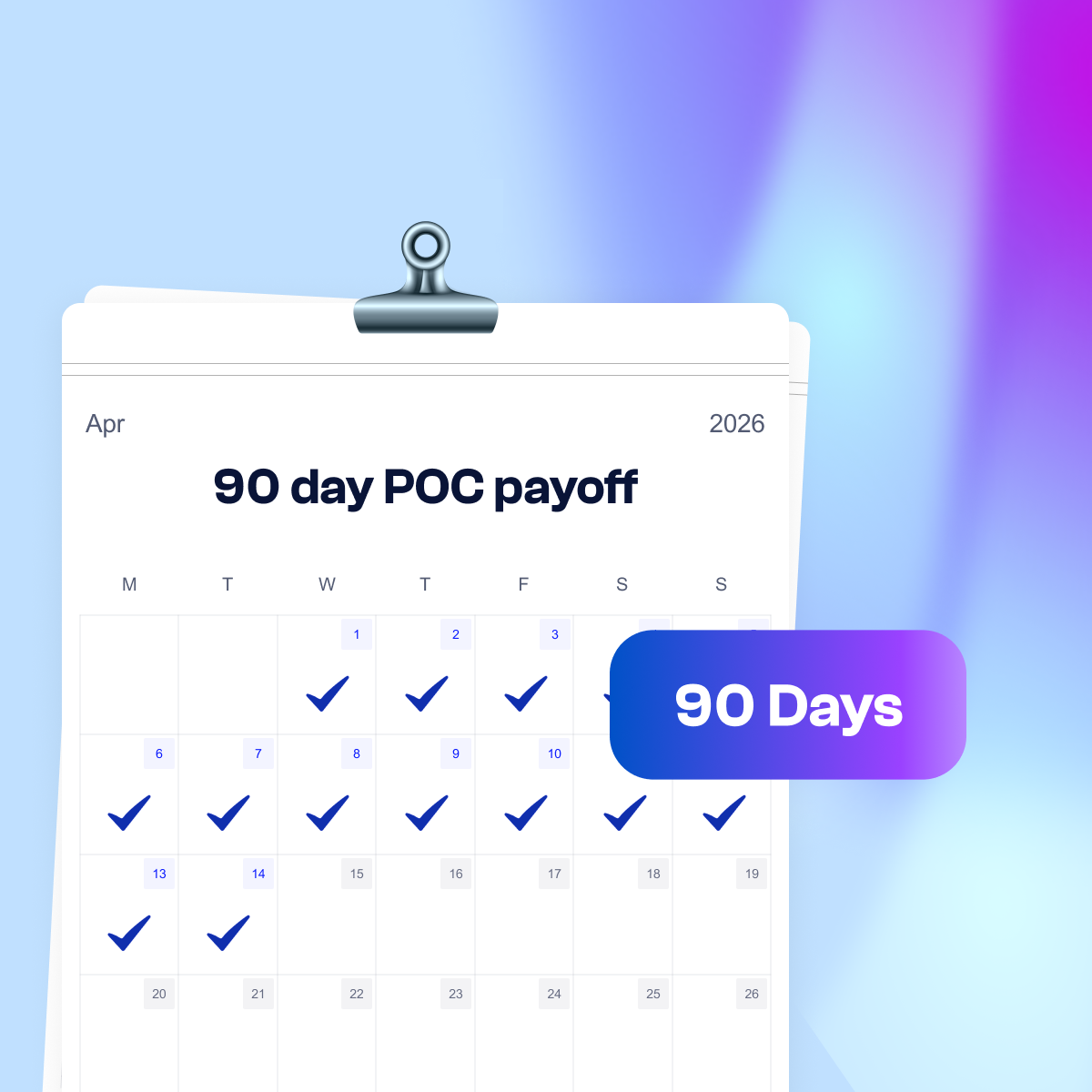
We have already made the case that a pilot, not a demo, is how you should buy orchestration technology, and why it safeguards your investment. The practical question comes next: what does a good pilot actually look like, and how long before it tells you something you can trust and assess the return on investment (ROI)? In this article, we explain what turns that window into proof.
Set your expectations: what to expect by day 90
Ninety days sits at the short end of the three-to six-month window most enterprises use before converting to a contract. It is deliberately focused because the goal at this stage should be proof, not a full rollout.
By day 90, you should have a clear before-and-after comparison for one operational metric, plus the business case to expand. Full network ROI comes after conversion. The job of the pilot is to fine tune and prepare that next step of evidence you have seen with your own data.
Start where the value is measurable
A pilot proves the most when its scope is focused. For trust-scored data, a pilot with Moddule’s ETA IQ could measure ocean freight arrival accuracy: the gap between the estimated and the actual time of arrival. It’s one number that’s easy to measure, and almost everything downstream depends on it.
Once arrival accuracy is trustworthy, the return shows up in the work your team already does every day. Four use cases qualify most often:
- Capacity recovery: your team stops chasing shipment status across disconnected systems.
- D&D reduction: predicted delays surface before they become demurrage and detention charges.
- Inventory optimization: confidence-scored ETAs support a smaller safety-stock buffer.
- Freight cost optimization: better arrival visibility supports smarter routing and consolidation.
To start, choose the one that matters most to your operation and align on its baseline on day one.
The 90-day structure
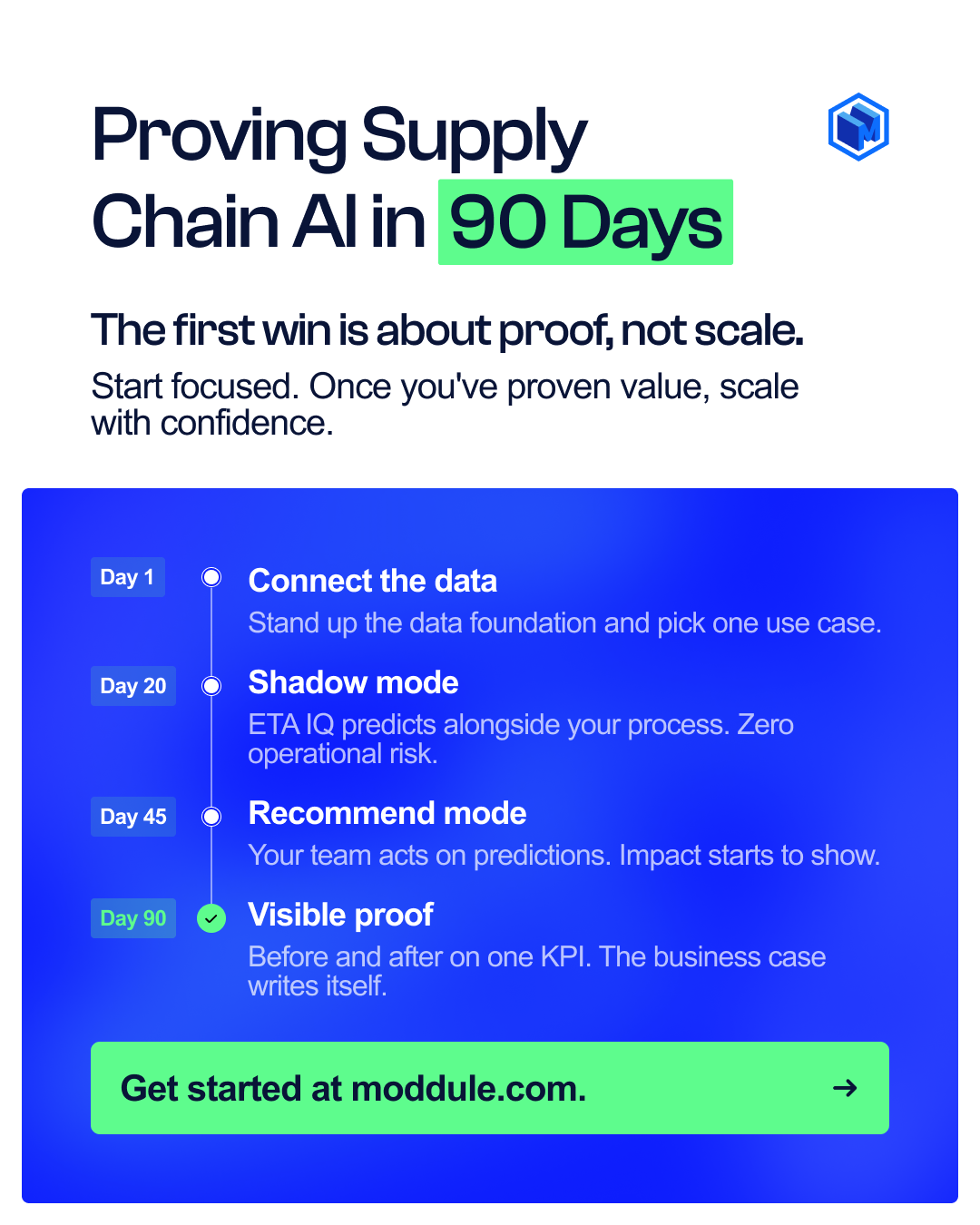
Day 1 to 20: data foundation and baseline
Where you start depends on your setup. If you already have the data foundation of Moddule’s Visibility Platform, you’re a step ahead. If not, this phase connects your carrier and systems data so shipments that are part of the pilot become visible. You leave it with one use case, one agreed baseline metric, and one named owner for the day-90 decision.
Day 20 to 45: shadow mode
Moddule’s systems run as an intelligence layer above your current process, producing predictions and confidence scores in the background. Nobody changes how they work today, so nothing is at risk. You compare predictions against actual arrivals as shipments close, and accuracy earns its credibility before anyone acts on it.
Day 45 to 75: recommend mode
Predictions begin to move into the workflow so your team can act on them selectively. Impact against the baseline begins to show. This is the first stage of the trust graduation model that Moddule OS is built around: trust is earned in stages.
Day 75 to 90: visible proof
You set the after-number beside the before-number in front of the room of decision makers, with the qualitative wins your team has felt. That evidence becomes the business case for the next use case and for wider rollout.
Why the structure protects your investment
Investment into AI can feel risky, and research shows it doesn’t always pay off. In fact, in 2026, 89% of operations leaders said their technology investments had not fully delivered the results they expected, with 87% pointing to poor data quality as a cause.
That’s why Moddule is built to prove the data can be trusted before you act on it. The 90-day structure is how that principle plays out in practice, and it rests on three safeguards.
- Running in parallel with your live process, the technology proves its accuracy without touching a single decision.
- A single baseline metric keeps success or failure unambiguous, with no moving target.
- Trust is graduated, so the system recommends before it acts and acts before it runs autonomously. On ocean arrival accuracy, for example, we want to see performance well above 90 per cent before anyone should trust a platform to act on its own.
You are never asked to trust the software more than the evidence supports.
Start with one win, then scale
The teams that succeed with AI in logistics rarely open with their biggest ambition. They prove one measurable win and let that fund what comes next.
Moddule runs structured pilots for ETA IQ and Moddule OS, built around your environment. If you want to see what a focused pilot looks like against your own lanes and your own data, talk to the Moddule team.