The Trust Graduation Model Behind Autonomous Execution in Logistics
In this article, we unpack why autonomous execution is an org chart problem before a tech one.


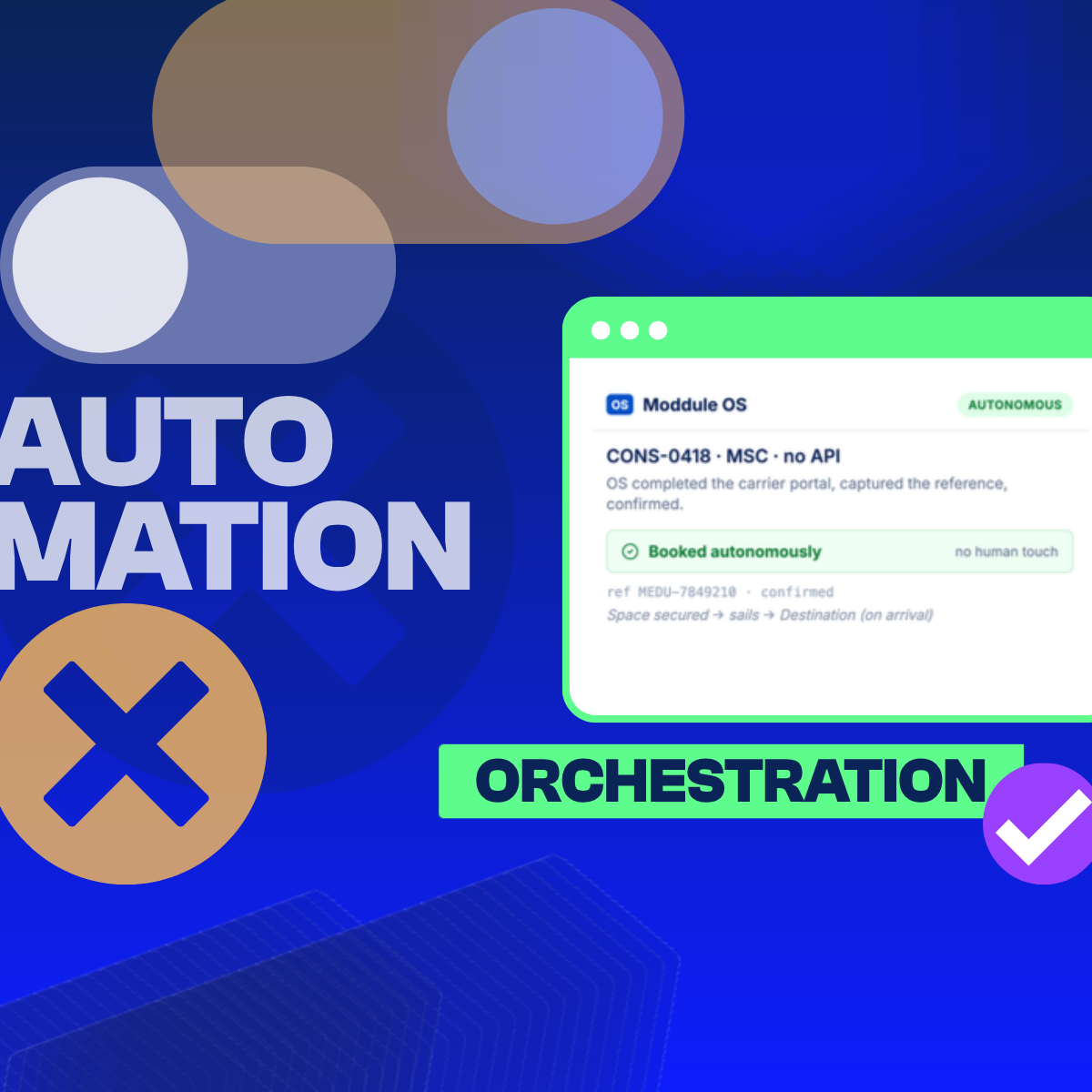
Earlier in this series, we argued two things: orchestration is not automation, and trust in an autonomous system is earned in layers, not switched on in bulk. Most operations leaders are convinced that the technology is necessary, and they’ve started asking a harder question: will I see quick ROI in my operations, and who’s accountable when it gets something wrong?
That’s why implementation must start with a look at your org chart.
When a system makes a call that turns out to be wrong, someone owns that outcome. When an organization decides it’s ready to hand a decision to autonomy, someone signs off on that readiness. Both are structural decisions most logistics organizations haven’t made yet.
This article explains the model that resolves both. We call it the trust graduation model. It’s the operating architecture behind autonomous execution, and it’s both an accountability model and a technical one.
The three steps of graduated trust
Autonomous execution doesn’t arrive all at once, and it shouldn’t. The trust graduation model has three layers of authority, three distinct relationships between the human and the system, running side by side across different decisions.
Recommend
Moddule OS analyzes the situation, surfaces the options and the reasoning behind them, and waits. The human executes the task and owns the result.
Act
Moddule OS surfaces a plan of action and executes it only with explicit approval. The human owns the approval, the system completes the task. The work is already done, so the decision is a conscious sign-off rather than a build.
Autonomous
Moddule OS acts inside a boundary that is authorized, with evidence that justifies it. The human still owns the outcome, because they set the boundary that the system executes within..
The part that matters is the impact this has on your org chart. Moving a decision to autonomy doesn’t remove accountability. It relocates it, from the operator making the call in the moment to the person who defined what the system’s allowed to do. And because each step up is earned on measured performance, Moddule OS produces evidence of its own value along the way.
Top barriers to ROI from autonomous execution
A third-party report analyzing the AI logistics orchestrators market named the biggest restraints on adoption. None are that the technology isn’t impactful. All three are organizational: the exact gates that sit between buying orchestration and realizing ROI.
Data quality
"Orchestration tools need clean item, order, and carrier data before recommendations can be trusted in daily execution."
The trust graduation model treats this as the first gate, not an afterthought. A decision doesn’t graduate past recommendation on a lane until predictions on that lane pass the threshold of accuracy. Bad data never reaches autonomous action, because it never earns the promotion.
Cybersecurity and data sharing
"Shared logistics workflows expose partner data, which raises security review requirements before implementation."
This is exactly why autonomous action runs on a named owner and a complete audit trail. Every action the system takes is logged and reversible, with a record that answers who did what and why.
Change management
"Teams that rely on spreadsheet routines need process redesign before automated recommendations become part of daily work."
The graduation model is the redesign. The Recommend phase is the on-ramp, the stretch where a team that has run on spreadsheets learns to read the system's reasoning and builds confidence one decision at a time, instead of trusting autonomy on day one.
Proving graduated trust: Use cases
The ROI in logistics AI is there, and operations leaders feel it. The difficulty is in proving and quantifying it. Graduated trust solves that because value accumulates at every step.
Destination management for a fashion retailer
A fashion retailer moves a seasonal range into a distribution center in the Midlands, inbound through Felixstowe, with delivery timed to a campaign launch. In the Recommend phase, the operations team watches Moddule OS flag a berthing delay, model the knock-on effect across transportation and the delivery slot, and lay out the resolution that protects the launch window, all before it’s authorized to act on any of it. Each recommendation is a measured data point: the time it saved, the demurrage exposure it avoided, the window it would’ve hit. That record is the evidence, and it’s what justifies promoting transport rebooking on that lane from Recommend to Act, and eventually to Autonomous.
Unified communications for grocery and perishable food brand
Chilled goods arrive into a temperature-controlled grocery distribution center on the US West Coast, through Long Beach, with a free-time clock running against a shelf-life clock. The organization might authorize Moddule OS to send customer delivery updates autonomously while a shipment sits inside SLA: low commitment, high precedent, and a clear record of the coordination time saved every time it runs. A decision that touches the cold chain stays in Recommend until the outcomes justify more. Same shipment, different authority for different actions, each level earned and each action logged.
That’s the difference: the team doesn’t take a leap of faith and hope for a return. They see the return before they extend trust, and they keep seeing it afterward, at scale.
Trust you can take back
Graduation only earns trust if it can also withdraw it. It’s the part that gets the least attention, yet is still key to the people who are signing off on it.
Authority is contextual, not global. What this means is that a carrier that has earned autonomous status on one lane hasn’t earned it everywhere. Authority narrows exactly where the evidence no longer supports it, and widens again when it returns.
Autonomy isn’t sensible if it can’t be clawed back if needed. A model that can only grant trust and never withdraw it hasn’t earned the right to hold it, and one bad autonomous day, handled badly, erases months of proven return.
Get the sequence right: graduation starts here
The restraints are all "before" problems: data before trust, security before sharing, process before autonomy. The trust graduation model is how an organization moves through this sequence, earning authority in specific contexts, on evidence it can inspect, with accountability that sits with a named person rather than dissolving into the software.
It’s the governing architecture of Moddule OS. It turns on when two questions are answered: who owns the outcome, and how you know you are ready for the next stage. Both are worth resolving before a platform goes live, and conversations that our orchestration specialists can guide you through. A conversation about where you are, what the graduation path looks like for your lanes and your team, and whether what we’re building fits the journey you’re on.