Great Storefront, Broken Supply Chain: The eCommerce Growth Trap
Most eComm brands overlook their supply chain, when it's really availability, forecasting, and data that drive growth.
.png)

For eCommerce brands, growth gets all the attention. Marketing, listings and conversion take the spotlight. The part that is often underestimated in its importance is the supply chain.
Moddule's Ben Jones sat down with Ant Willis, founder of Ecomm Growth Club and an advisor with 15 years spent helping eCommerce brands grow across in-house, distribution and agency roles. They discuss why availability is the most overlooked driver of growth, how the best operators forecast, and why the value of AI comes down to the quality of your data. Here are the five top takeaways.
1. The hidden cost of a stock-out
Willis is direct about the most overlooked risk facing a growing brand: what happens the moment a top seller runs out of stock unexpectedly.
"Going out of stock of a good selling product is single-handedly the quickest way to ruin any sales rank traction that you've built up. If you go out of stock for a week or more, you essentially throw away all the efforts that you've put into building the traction up on that product."
And once the customer has moved on, winning them back is close to impossible:
"Nobody's going on Amazon with the intent to buy something and then being happy to wait a month. Everything's instant now. If you can't buy something and if it doesn't arrive tomorrow, there's a good chance you're going to lose that sale."
Availability sits upstream of every revenue number a brand cares about. Lose that and the traction goes with it. For any BCO, that makes visibility over stock and demand a commercial priority.
2. Forecasting is what separates the winners
When Jones asks what the strongest brands do differently, Willis is quick to point to forecasting.
"The best businesses that I've seen that operate in the space forecast meticulously for the whole year. They understand exactly when the stock's coming in, and they've got all of their ordering process done and ready for the whole year."
The brands that struggle tend to set stock orders on a fixed schedule and react when something goes wrong, often to find the replacement two months out on a container. Accurate forecasting gives you the room to flex, reorder early, or cancel before an overstock lands. It turns supply chain from a series of surprises into a plan you can adjust.
3. Overstock has its own price tag
Carrying extra inventory feels like the safe hedge against a stock-out. Willis is clear that it comes with its own bill.
"Whilst overstock from an Amazon perspective is more favourable than being under-stocked, from a business perspective you'd definitely rather sell out than be sat on a load of stock."
Over-order and you tie up cash, pay to store product you haven't sold, and often end up discounting or spending marketing budget to clear it. Both under and overstocking issues trace back to the same root cause: a forecast that wasn't good enough. Getting the balance right is where margin is won or lost.
4. AI's real power is unified, accurate data
Willis sees a gap between how eCommerce brands talk about AI and where the value actually sits today. Most people picture a chatbot, but he see the opportunity as installing it on top of your own operational data.
"If you've got all of the data in one place, as long as that data is accurate, all the AI is doing is scraping that information and delivering you data in a format that's going to make things really easy for you. So the error rate is going to be super low, as long as the information that it's pulling from is correct."
Work that takes one person weeks across 200 SKUs, pulling category trends and building forecasts by hand, becomes near instant. The condition Willis keeps returning to is data quality. Unify your operational data and keep it accurate, and AI has something reliable to act on. Leave it fragmented across systems, and no model will save you.
Read more: Navigating Skepticism to Build the AI-Powered Supply Chain of the Future
5. From flagging problems to acting on them
The most interesting shift, in Willis's view, is the move from systems that tell you about a problem to systems that resolve it. He acknowledges the hesitancy around letting software act on a shipment, then explains why he thinks it fades.
"The thing that I think people will start to realise over time is it's a machine. If it's trained properly, it won't make a mistake. I think it's probably the most exciting part of implementation, if I'm honest."
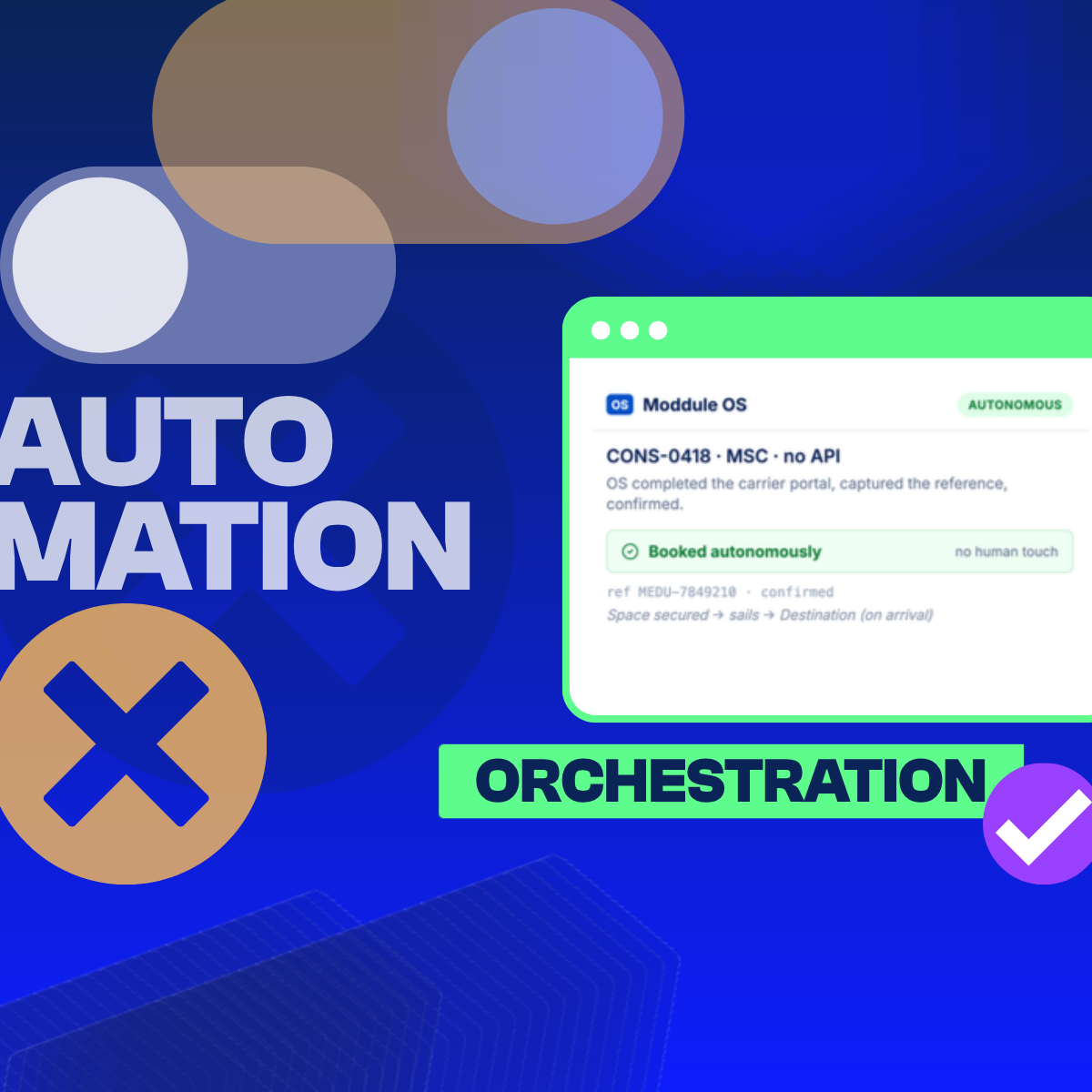
Jones framed the distinction in the interview as automation versus orchestration. To implement orchestration well, trust in that step gets earned gradually rather than handed over up front:
"I think there's a trust and adoption curve to it. Full orchestration out of the gate might be a bit too much of a leap for certain companies at this stage. But the ability to work alongside it, so you build that trust, is probably more of the adoption curve that we'll see."
That progression, from recommendations a human approves to a system that acts and reports back, is the same one Moddule sees across its customers, from visibility, to prediction, to autonomous execution.
Watch the full interview
The full conversation between Jones and Willis covers these topics and more. Watch it on YouTube.
Ready to put these data accuracy and a trust graduation model into practice? Moddule helps brands and their logistics teams unify operational data they can rely on, then move from recommendations to predictions to actions they can trust to run on their own. Talk to our team to see the platform in action.