Three Principles That Separate Orchestration From Automation
Here are the three principles that make autonomy trustworthy: graduated trust, legibility, and intervention.

When an ocean container arrives two days late, the impact is felt across your operation, requiring updates across multiple systems and people. Automation can speed up the steps that need to be taken, but it doesn’t decide which one matters most. That gap is the difference between automation and orchestration, and it identifies whether a platform can be trusted to act on your behalf.
We have already discussed that the director era has arrived. The operator's role in logistics is shifting from execution to oversight. Now we are sharing what designing for that shift actually requires (and the cost of getting it wrong).
Automation is not orchestration
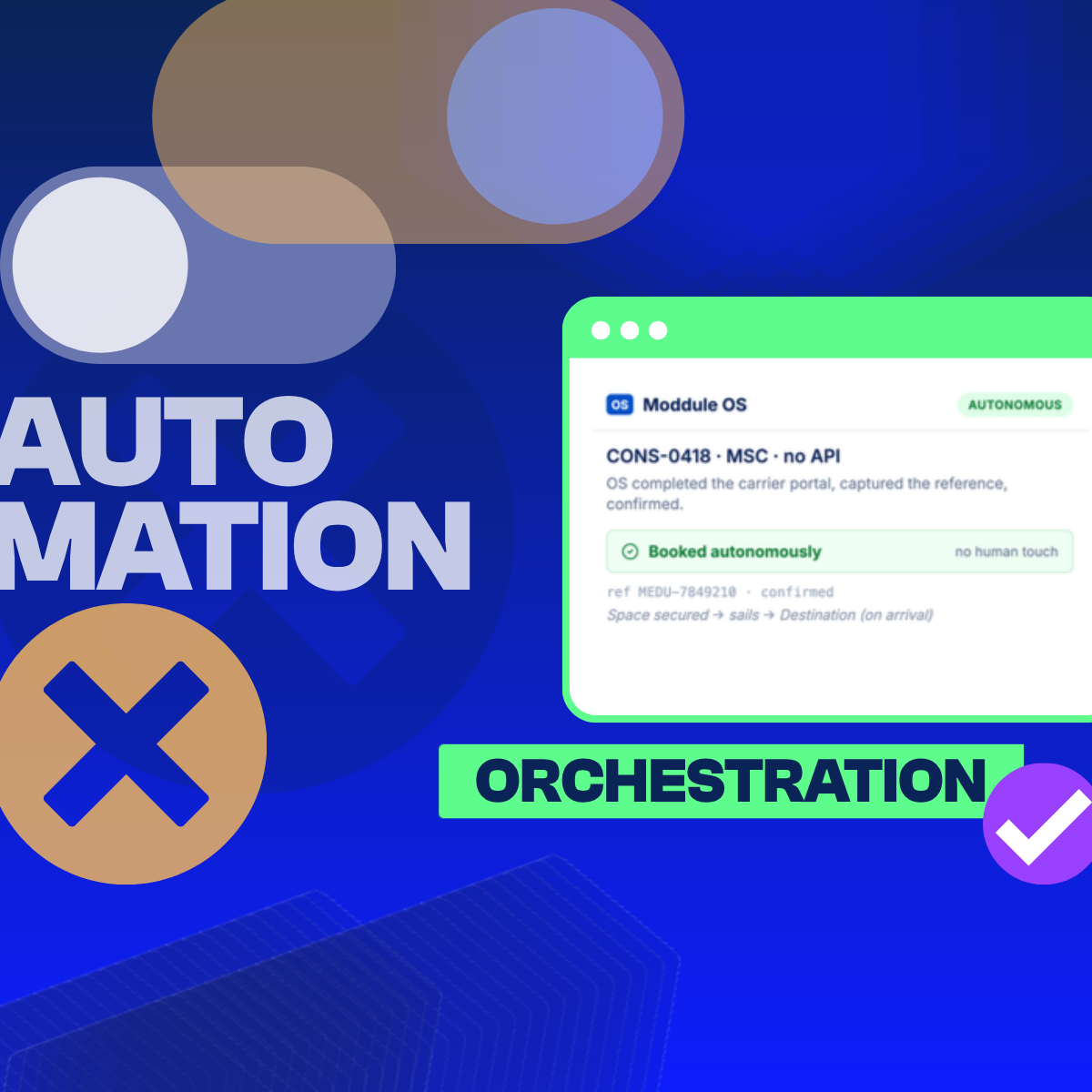
Automation and orchestration are often conflated. The two get blurred constantly in how logistics technology is discussed, but they are not the same thing.
What is automation in logistics technology?
Automation executes predefined sequences. If X happens, do Y. It is rule-based, linear, and most effective inside its programmed boundaries.
Example: A workflow that emails a customer when a shipment status changes is automation. So is a rule that flags a container over its free days. These tools have real value, and they have been available for two decades.
What is orchestration in logistics technology?
Orchestration is structurally different. It coordinates decisions across multiple systems and stakeholders, weighs the trade-offs against context and confidence, and selects the best available response inside human-defined guardrails.
Example: When a predicted delay triggers not just a notification but a recalculated warehouse schedule, a pre-composed customer update, a revised ERP delivery date, and a cost-optimised drayage rebook, all coordinated across four systems in seconds, that is orchestration.
The design requirements of automation and orchestration are completely different. Automation can be bolted onto a platform as a feature, while orchestration means rethinking the relationship between human and system from the ground up. Automation wearing an AI badge is not orchestration, and an interface built for automation can’t serve orchestration directors.
The three principles of directed autonomy
Directed autonomy is the design philosophy for how orchestration platforms should be experienced by the people responsible for them. It rests on three principles, and while understanding each is straightforward, understanding what getting it wrong looks like in production is what makes it useful.
Principle 1: Trust is earned in layers, not granted in bulk
Most implementations treat autonomy as a binary switch: configure the rules, turn it on, let the system run. That breaks the moment something unexpected happens, and in global logistics that is every day.
The problem is not the automation, but that the bulk-granted trust has no way to calibrate. Acting autonomously on a well-understood lane with a high-confidence carrier is appropriate, however, applying the same autonomy to a routing scenario with an unfamiliar carrier during a port disruption is dangerous. A binary model can’t tell the two apart, and this leads to errors.
This is where a graduated model comes in. The system earns the right to act with more autonomy in specific contexts based on demonstrated performance, and that authority can be pulled back where performance slips without switching off the intelligence everywhere else. It moves through three modes:
- Recommend: the system proposes, and the team approves
- Act: the system executes inside tight bounds and reports
- Autonomous: the system runs a well-proven context on its own
A carrier that earns autonomous status on one lane has not earned it everywhere. For example, a corridor that runs autonomously in normal conditions can revert to supervised action during a disruption.
Use case: A Director of Operations at a 3PL sets carrier swaps to execute autonomously on the TPEB corridor for carriers scoring above 88% on-time and 91% ETA accuracy over 90 days. Hapag-Lloyd clears both thresholds, so its swaps run on their own. ZIM does not, so the system recommends and waits for sign-off. Same corridor, different authority, calibrated to performance.
Principle 2: Legibility matches the altitude of each persona
Too much information isn’t always helpful. A director who opens the platform to a live feed of every autonomous action taken today, every carrier swap, every ERP update, every pre-clearance submission, is not more in control. They are buried, and a buried director turns the automation off.
The right question is not how much to surface but what each persona needs to do their job.
Use case: The VP is at 35,000 feet and needs to know the system made 847 decisions, saved $14K, and flagged one call for human judgment. The operations manager sits lower and needs the reasoning behind specific actions. The operator works at container level. A platform that serves all three the exact same information serves none of them.
Reasoning has to be legible too, not only outputs. "Carrier swap executed. Werner's on-time score on this lane fell to 68%, below the 80% threshold for autonomous action. J.B. Hunt at 94% was the next qualified carrier. Cost impact neutral, ETA improved four hours." That is legible to a human. "Action: carrier_swap, status: completed" is not. This distinction is one of the biggest gaps in most logistics platforms today.
Principle 3: Intervention is an architecture, not a button
This principle gets the least attention during design and causes the most damage when it is missing. Something goes wrong: the system has been executing confidently, then an edge case appears, a scenario outside its parameters or a disruption that changes the maths on three shipments at once. It recognises it needs human judgment and escalates.
What happens next depends on how intervention was built. In most platforms it is an afterthought, a notification and a button. If the system was mid-execution on a multi-step action, the human has no way of knowing what is already done, what is queued, and what an override will cascade into. This is the moment that destroys trust in an autonomous system, and trust is very hard to rebuild once broken.
Use case: Intervention as architecture means designing the handback as carefully as the execution. It needs context so the human inherits the full picture. This equates to clean handoff boundaries, so the system can pause at defined points and resume once a decision is made, and graduated re-engagement, so the system folds the human's decision back in as learning rather than treating it as a reset.
Read More: From Visibility to Orchestration: Moddule’s Product Roadmap
The three work as one system
These three principles shouldn’t be treated separately. Each one is required for success. Trust sets the boundaries, legibility makes them evaluable, and intervention lets the director move in and out of them without disruption.
These three principles are the line between an orchestration platform that is trustworthy and one that gets quietly switched off. They also raise the questions worth putting to any vendor claiming autonomy:
- Does the trust model graduate by context and evidence, in a way you can inspect and adjust?
- Does every persona get information at the right altitude, enough to stay in control without drowning?
- When the system needs human judgment, does the handback preserve context, define boundaries cleanly, and let people re-engage without disruption?
Get one wrong and the other two collapse as well. Get all three right and autonomy stops being a leap of faith and instead becomes something operations teams extend deliberately, lane by lane, as the system earns it.
This is the standard we are building Moddule OS to, and how all orchestration technology should be evaluated. Get in touch with our team to see what orchestration looks like when trust, legibility, and intervention work as one system.