Industry

Industry
10 minute read
Whether you're a logistics professional evaluating new tools or a supply chain leader trying to understand where the industry is heading, we’ve got the answers to the top-searched questions.
.png)
AUTHOR
Moddule Team
Supply chain visibility is the ability to track the movement of goods, shipments, and inventory across your entire network, in real time, from origin to final delivery.
In practice, this means knowing where a container is right now, whether it's on schedule, and what downstream impact any delay will have on your warehouse, your customers, and your commitments. It covers ocean, air, road, and rail, and ideally, all of them in a single view rather than spread across multiple carrier portals.
Visibility sounds like table stakes. For many operations, it still isn't: data arrives late, lives in different systems, and can't be trusted. Getting visibility right is the foundation everything else depends on.
Read more: See How Moddule's AI-Powered Intelligence Suite Can Change Your Operations
Without visibility, logistics teams are reactive by default. The cost is real, even if it's hard to see on a single line of a P&L: operations teams spending hours on manual status checks, customer service fielding shipment queries that a tracking portal should answer, and exceptions that surface too late to do anything useful about. Visibility doesn't eliminate those problems overnight, but it changes their nature, from firefighting to early intervention.
A visibility platform ingests data from every carrier, and logistics system you work with, normalizes it into a common format, and surfaces it in a single dashboard or single data feed via an API. Integrations connect to TMS, WMS, and ERP systems so that tracking data flows bidirectionally, status updates come in, and changes cascade across connected systems automatically.
The keyword is normalize. Your TMS, ERP, Ocean carriers, air freight providers, trucking companies, and warehouses all use different data structures and timelines. A visibility platform's job is to ensure they speak the same language.
Moddule's Visibility Platform does exactly this, ingesting multi-modal shipment data, surfacing exceptions, and providing customer-facing dashboards that 3PLs and freight forwarders can white-label as their own.
The benefits stack across three areas:
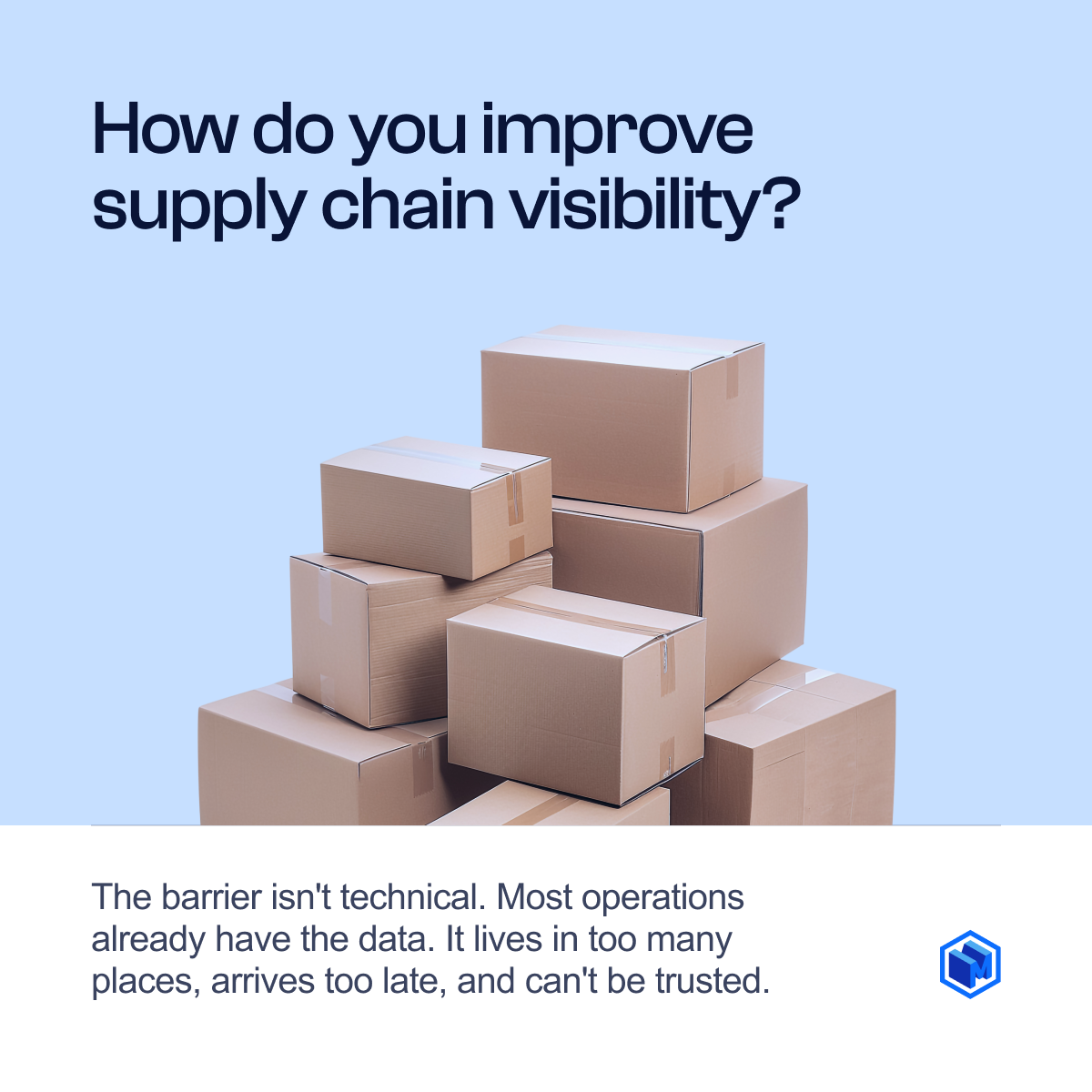
The most common barriers aren't actually technical, but structural. Most operations have the data, however, it lives in too many places, arrives too late, and can't be trusted enough to act on.
Improving visibility means:
The biggest shift is moving from scheduled reporting, weekly status updates, manual check-ins, to continuous real-time data. That changes how quickly operations teams can respond.
A predictive ETA (estimated time of arrival) is an arrival forecast generated by a machine learning model rather than taken directly from a carrier's schedule. Instead of relying on a carrier's stated departure and arrival times, a predictive ETA accounts for real-world variables: port congestion, vessel performance history, weather, customs processing patterns, and historical accuracy on that specific trade lane.
The practical difference matters: carrier-provided ETAs are frequently wrong by days, sometimes more. Ocean freight schedule reliability has declined to around 60%. Predictive ETAs close that gap significantly by incorporating signals the carrier's own system doesn't factor in.
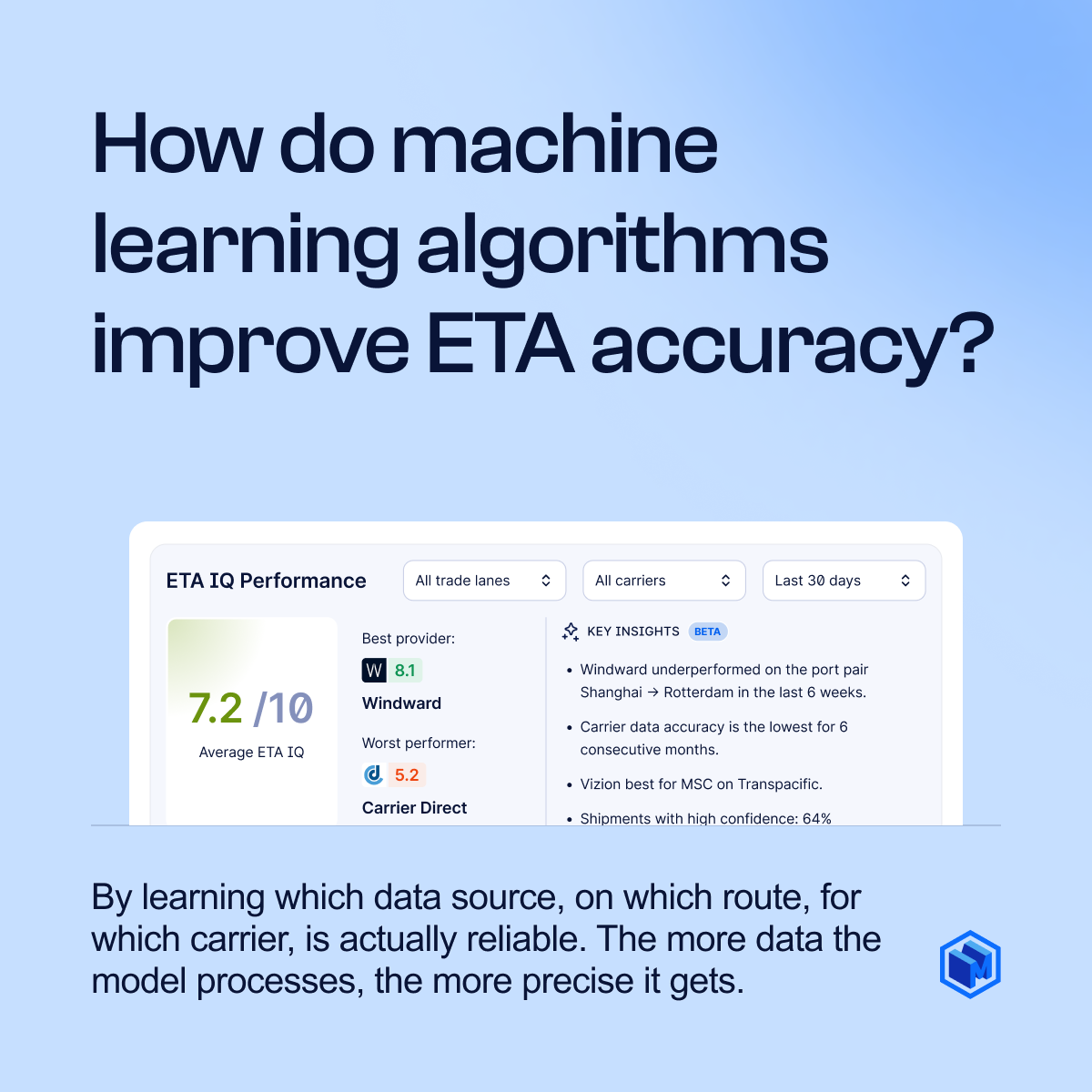
Different data sources are more or less reliable depending on the context. A carrier's own ETA may be accurate for certain routes and unreliable for others. Port congestion data from AIS may be more predictive than carrier feeds at certain stages of the journey.
ML models learn these patterns over time, identifying which provider, at which point in the journey, for which carrier and port pair, produces the most accurate prediction. The more data the model processes, the more specific and reliable this gets.
This is the approach behind ETA IQ, Moddule's predictive milestone intelligence engine. Rather than generating a single new prediction and competing with carriers, ETA IQ scores the accuracy of multiple providers' predictions simultaneously, assigning a trust score (0-100%) to each one so operators know which ETA to plan against.
The financial impact of ETA inaccuracy compounds across the supply chain. Safety stock costs, warehouse overtime triggered by late or early arrivals, demurrage and detention charges are all tied to how reliable your arrival forecasts are.
More accurate ETAs mean tighter planning, lower inventory buffers, fewer missed delivery windows, and stronger customer communication. For a large BCO, the reduction in demurrage and detention alone can justify the investment. For a 3PL, the competitive advantage is customer confidence, the ability to tell a shipper which ETA to trust, not just relay what the carrier said.
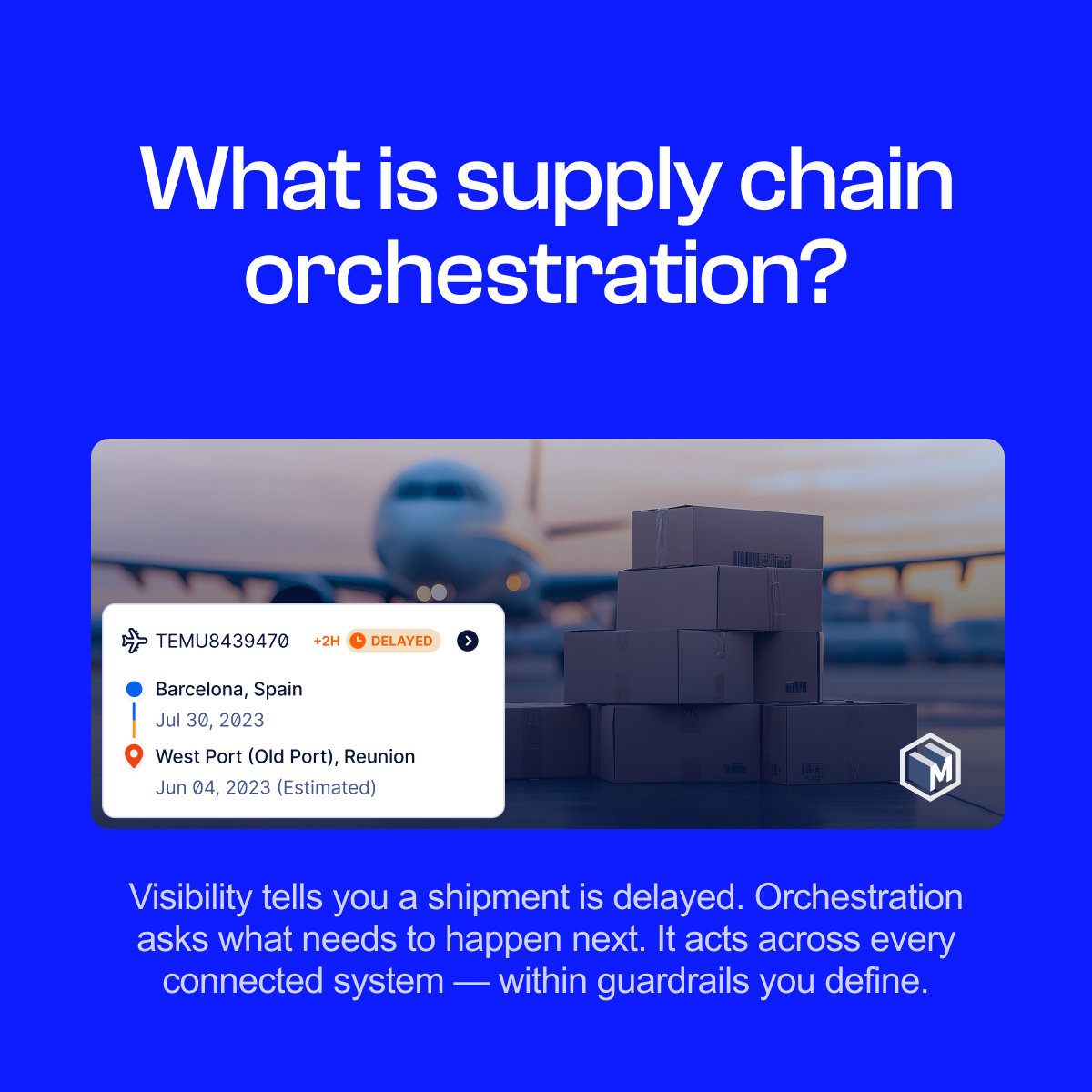
Supply chain orchestration is the ability to not just see what's happening across your network, but to act on it, automatically and across all connected systems simultaneously.
The distinction from visibility is important. Visibility tells you a shipment is delayed. Orchestration asks: what needs to happen next? It identifies the downstream impact, which warehouse booking needs to move, which customer commitment needs to be updated, which carrier needs to be notified, and either recommends those actions or executes them, depending on the confidence level and the rules you've defined.
Most supply chain software stops at visibility. Orchestration is the next step, and it's where the industry is heading.
Read more: Supply Chain Orchestration Takes Logistics Professionals From Driver to Director
Automation executes predefined rules: if X happens, do Y. It's useful, but it can't weigh trade-offs or adapt to context.
Orchestration coordinates intelligent decisions across multiple systems and stakeholders. It evaluates options, applies confidence levels, and selects the best response, within human-defined guardrails. It doesn't just execute rules; it makes judgment calls on your behalf.
Moddule OS is an orchestrator, not an automation tool. It consumes trust-scored predictions from ETA IQ, assesses the downstream impact across connected systems, and determines the right response, recommending, proposing, or executing depending on the confidence level it has earned.
Three things matter most when selecting a tool for orchestrating your entire supply chain.
Yes, and it should, without requiring you to replace anything. The value of orchestration comes from coordinating the systems you already have, not adding another monolith to manage.
Modern orchestration platforms connect via bidirectional APIs, reading from and writing back into your ERP, TMS, and WMS. This means an orchestration action, say, adjusting an inbound delivery date because ETA IQ flagged a high-confidence delay, can automatically update your ERP date, queue a warehouse reschedule, and trigger a customer notification, all from a single predicted event.
Learn more: Announcing Moddule’s Product Roadmap That Takes You From Visibility to Orchestration
No, but it will fundamentally change what supply chain professionals spend their time on.
The shift is from manual coordination and reactive firefighting toward decision oversight and exception management. AI handles pattern recognition, status monitoring, and downstream impact assessment. The human remains responsible for strategy, judgment calls that fall outside defined guardrails, and accountability.
The teams that benefit most from this shift are the ones that embrace it intentionally, defining clear rules for what the system can act on autonomously, and retaining control over the decisions that require human judgment.
Visibility, predictive intelligence, and orchestration aren't three separate categories of software, they're three layers of the same problem.
Moddule is built as a single stack across all three: Visibility Platform creates the unified data foundation; ETA IQ applies trust scoring and ML to make that data actionable; Moddule OS translates intelligence into coordinated action across your systems. Each layer delivers standalone value and enables the next.