Supply Chain Orchestration Starts With Your SOPs, Even If You Have None
Most logistics SOPs are outdated, conflicting, or never written down. Here’s how supply chain orchestration turns them into autonomous decisions.

Moddule is ready to take on one of the biggest challenges in logistics: making sure SOPs are executed accurately and kept up to date efficiently. Before we share how, let’s look at the challenges operations face today.
One rulebook sits underneath every supply chain orchestration platform worth the name: the system has to know what it is meant to be orchestrating. It sounds obvious, but in practice, it is where most operations are least prepared.
In logistics, that knowledge normally lives in a standard operating procedure (SOP). The SOP sets out how everyone involved is expected to act in any given circumstance. The reality for most businesses is that if they exist at all, many might be years old and sitting in a shared folder that rarely gets opened.
We have already covered why the operator’s role is shifting from driver to director, and the return on investment of supply chain orchestration. With that understanding in place, this article focuses on the first step to setting the operating logic that allows orchestration, and eventually autonomous logistics execution, to happen.
Every operation already runs on instructions
Every logistics operation, whether it moves freight for others or for itself, runs on a set of instructions:
- Which carrier gets priority on which lane
- When a customer wants a call and when an email will do
- How much free time is worth protecting before you pay for an early collection
- Who signs off on an air freight upgrade when an ocean shipment is about to miss a promotion date
Whether they’re formally documented or not, these rules are what make your operation yours. Two LSPs on the same transportation management system (TMS), moving similar volume through the same route, might still make different calls on the same delayed container because their customers, contracts, and cost tolerance are different. The software can be identical, but the operating logic isn’t.
That operating logic is what a logistics orchestration platform has to learn before it can act. Carrier data and ETA predictions tell the system what is happening, but the SOP tells it what you want done about it. This is the line between supply chain automation software, which repeats a task, and orchestration, which decides what should happen next.
Related: Three Principles That Separate Orchestration From Automation
That makes your SOPs the natural place to start, even if you don’t fully trust their accuracy. Most teams know their documentation is out of date or incomplete, and that is fine. It only has to give the system somewhere to begin.
Very few operations have that logic in a form a system can read. In our conversations with LSPs and BCOs over the last few months, here’s what we’ve seen:
Problem: the LSP with no SOPs
The first use case for this pre-orchestration step that we’ve seen is a mid-sized LSP handling ocean imports. It is well run, with experienced people and loyal customers, yet it has no documented SOPs.
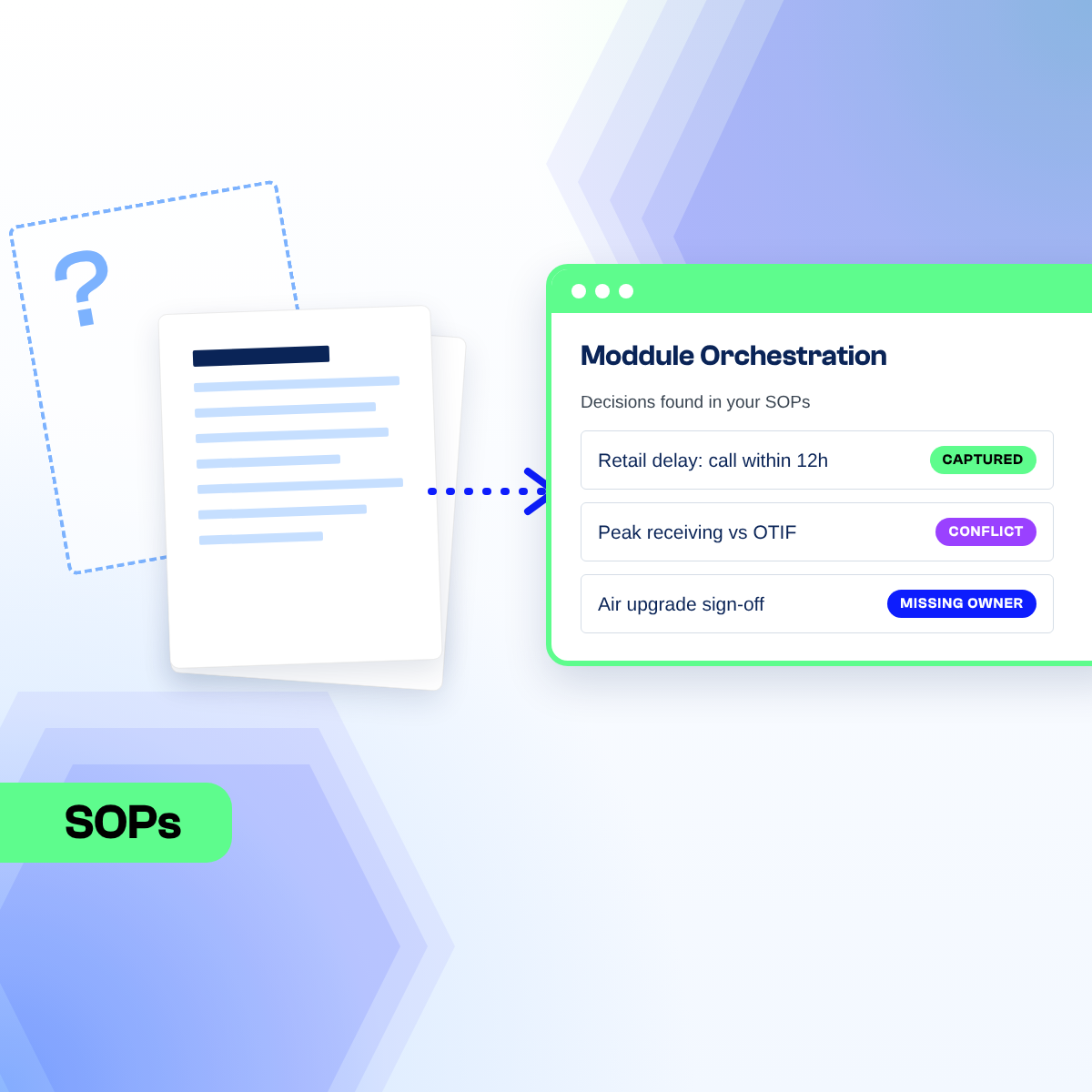
Ask how its largest retail account wants a delay handled, and the answer is to ask the coordinator who has run it for years. She knows the LSP’s standard is to confirm a revised delivery plan within 24 hours, but this customer expects it within 12, and by phone when a promotion is at risk. None of it is written down.
That works while she is in the office. But when she is on vacation, service slips, and new hires take months to learn the intricacies of the account.
For orchestration to be successful, it needs somewhere to start. You can connect your TMS, WMS, and ERP and feed in trust-scored ETAs, and the platform still won’t know this customer needs a call within 12 hours rather than an email within 24. A system can’t act on knowledge that only exists in someone’s head.
More Like This: Unify Your Logistics Data Without Replacing Your TMS
Problem: the BCO with hundreds of SOPs
The second example we’ve encountered is a large global food and beverage BCO importing thousands of containers a year. Its problem runs the other way: it has hundreds of SOPs, written by different teams at different times, and several contradict each other.
Take a two-day delay on a vessel carrying promotional stock for a national grocery chain. The corporate SOP says protect the retailer’s delivery appointment to avoid on-time, in-full penalties, while the distribution center’s SOP says no unplanned inbound during peak receiving. An experienced planner settles that with a couple of phone calls. A system given both documents will either stall or pick one, and nobody can say which it should pick.
For enterprise supply chain orchestration, writing more SOPs would only make this worse, because the conflicts aren’t obvious until a system acts on one. For supply chain exception management, that is the worst possible moment to find them.
You May Also Like: 5 Logistics Data Disasters Killing Your Automation Dreams
Both problems have the same solution: decision-level clarity
These two operations look like opposites. But if both try to orchestrate today, they fail for the same reason: the operating logic isn’t in a form a system can act on.
The LSP needs its knowledge captured and the BCO needs its knowledge reconciled. You don’t need good SOPs, or any SOPs, before you start with Moddule Orchestration. What orchestration needs is clarity at the level of the decision, and getting there is its job.
Related: How to Evaluate Supply Chain Orchestration Tools
Your SOP is the starting point for supply chain orchestration
The SOP is where orchestration starts, and the decisions inside it are what it runs on: who acts, when, in which system, and where a person has to make the call.
Whether you have no SOPs or hundreds, this is work most teams never get to, because there is always a more urgent shipment in the queue. That’s why Moddule Orchestration does that work. Give it the SOPs you have, however incomplete, and it pulls out the decisions, flags what is missing, and asks your team to resolve it. If you have no SOPs at all, it takes your team through those decisions one by one and builds the SOPs from the answers.
Either way, the result fits your operation. That is the first step toward an autonomous supply chain built on your rules, not a generic template.
Over the coming weeks, we’ll share how Moddule helps customers and partners execute their SOPs quickly and accurately, keep them up to date, and maintain the highest level of process integrity.
Read More: The 90-Day Path to Proof for AI Logistics Tech
Get in touch with our team to see how Moddule can turn your SOPs, however many or few, or none at all, into the foundation for orchestration.