Unify Your Logistics Data Without Replacing Your TMS
Upgrading your customer experience doesn't have to mean changing legacy systems. Moddule is the CX layer that turns siloed systems into one pane of glass.
.png)

For logistics providers today, moving goods efficiently is not enough to grow your business. It’s essential to go beyond the expected and provide a truly differentiated client experience that modern BCOs expect.
And while you might rely heavily on your core technology, many traditional systems, including your transportation management system (TMS), fail to deliver a top-notch customer experience that differentiates you from competitors.
Now, this doesn’t mean you need to tear out these legacy systems. Not only would it cost money and time to rip and replace, but you’d be left with operational gaps.
What logistics providers need is to layer on a modern CX platform on top of their TMS and other systems to help solve the issue of fragmentation and to provide customers with a unified experience.
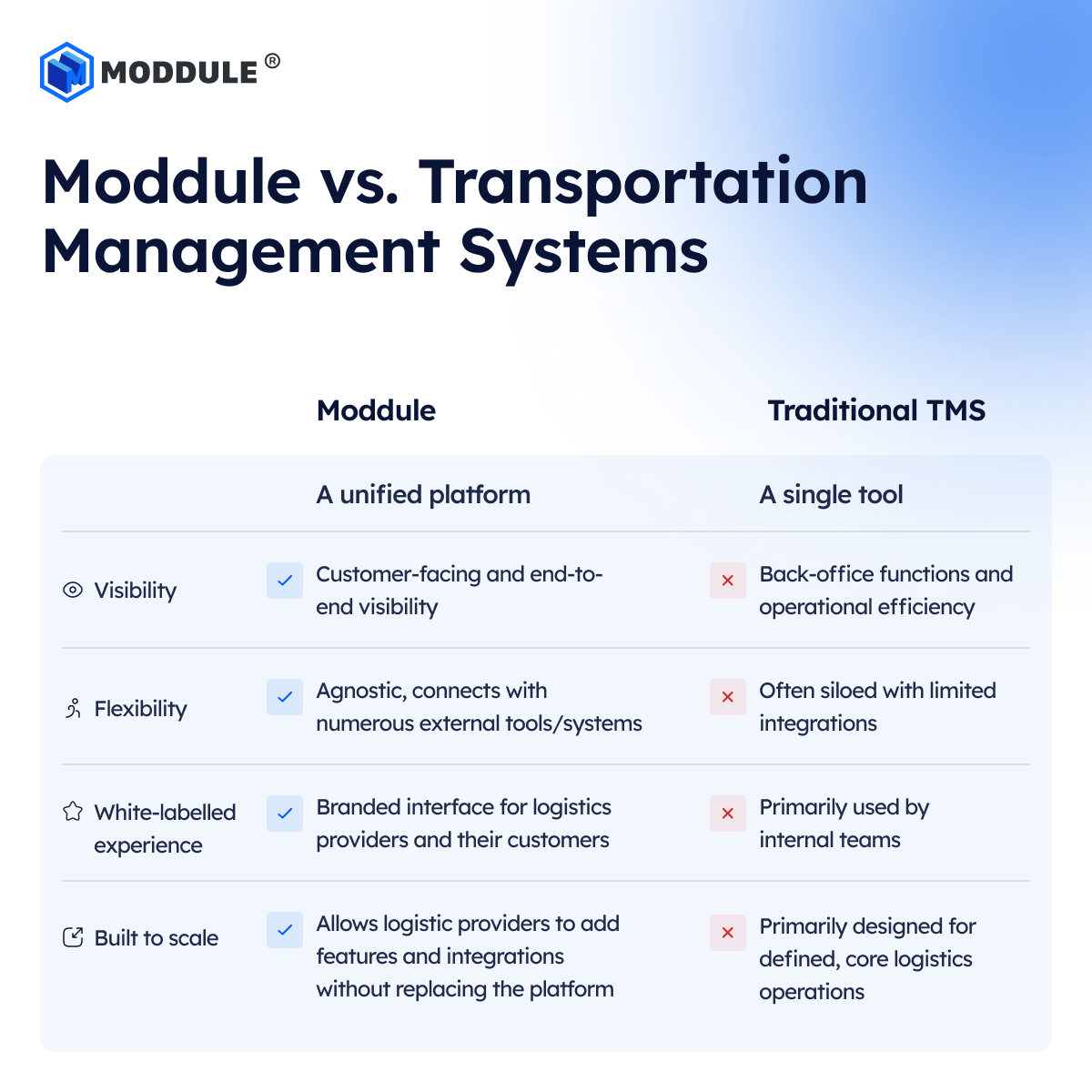
TMS vs. Moddule's Visibility Platform: What’s the difference?
First, it’s important to understand the fundamental difference between the two solutions.
What is a traditional TMS?
A traditional TMS is a single tool that acts as an essential back-office engine for planning, execution, and shipment tracking. A TMS is built for operational efficiency and transactional processing. It handles internal tasks like route optimization, booking, billing, and documentation.
What is Visibility Platform?
Visibility Platform is Moddule's modern, client-facing layer that sits above the TMS. It aggregates disparate data from all your internal systems and enriches the data via third-party sources into one unified experience, or a "single pane of glass" for your customers. Adding Moddule to your technology stack allows logistics providers to focus on external growth, customer retention, and market differentiation.
Common problems your TMS alone can't solve
With that in mind, here’s how a layered tech stack can help logistics providers overcome some of the top issues that hold back business expansion.
Customer experience is fragmented and underwhelming
Logistics providers and their customers are forced to bounce between portals, emails, spreadsheets, and PDFs (to name a few) to get basic information. Account teams, in turn, spend hours chasing updates across tools and consolidating data, which slows response times and leads to client dissatisfaction.
Why it happens: A TMS is engineered for internal transactions, not customer experience. Data stays siloed across systems, so customers feel the gaps.
How to fix it: Moddule creates a neutral, carrier-agnostic layer above your TMS to normalize shipment, order, and inventory data into a single customer‑ready view. Visibility Platform allows for self‑serve tracking, daily AI-powered summaries, and custom reporting, so customers can find answers without opening tickets or picking up the phone.
Use case: A retail BCO logs into a logistic provider’s branded portal to see live milestone tracking across ocean and air, subscribes to exception alerts, and stops emailing the ops desk for “Where is my container?” updates.
See more: Moddule transforms LGI Netherlands’ onboarding process, boosting revenue and efficiency.
Teams waste time chasing data and answering repeated questions
Ops and sales often toggle between TMS, WMS, spreadsheets, and email threads to compile status updates. That manual work scales linearly with volume, which introduces delays and errors.
Why it happens: A TMS executes transactions well, but doesn’t unify data across systems or partners. Each point solution has its own model and UI, which forces swivel‑chair work and one‑off exports that go stale minutes after they’re made.
How to fix it: Visibility Platform centralizes operational and partner data for true end-to-end visibility. Automate notifications, exception routing, and standard docs, and share live links so everyone works from the same real‑time truth.
Use case: An ops lead consolidates warehouse and carrier feeds into one dashboard, where exceptions auto‑assign to the right owner, cutting the daily status emails by 60 percent. This time back can be reinvested into business growth rather than maintaining the status quo.
It’s risky and costly to replace an existing TMS
Full software replacement projects create downtime and require significant resources to implement and retrain. If modernization is the goal, speed is essential to get there.
Why it happens: The TMS is the operational backbone, so changes to improve CX require long IT queues and retraining, which is a high cost. It’s a gamble for an uncertain payoff.
How to fix it: Keep your existing TMS and layer Moddule on top. Ship value in weeks, not years, while de‑risking the core business.
Use case: During peak season, IT adds a new carrier visibility feed via API without touching the TMS UI, and customers see enhanced milestones the same day with Moddule.
Related: How technology is finally offering solutions to supply chain disruptions.
There is limited differentiation in the market despite strong operations
From the outside, logistics providers look similar, so the difference is hard for customers to understand. You need a way to prove your operational excellence.
Why it happens: Back office tools optimize for internal use, not for selling your brand to customers. In a TMS‑only world, deals hinge on price or your existing network.
How to fix it: Package your operational strengths into a branded, customer‑ready experience. Moddule’s white‑labelled and shareable dashboards allow customers to see your reliability, speed, and service.
Use case: A regional 3PL creates role‑based views (e.g. warehouse managers monitor fulfillment SLAs while customer service focuses only on exceptions) so meetings with customers focus on actions, not data hunting.
Book a customized demo to see how Moddule can turn fragmented operations into a unified, customer‑ready view. And stay ahead with actionable logistics insights by subscribing to our monthly newsletter for supply chain software advice and industry news.