5 Logistics Data Disasters Killing Your Automation Dreams
Learn the five data pitfalls sabotaging your ROI and how to move beyond manual integrations to true, end-to-end workflow automation.

Would you agree that digital transformation in logistics often feels like a high-stakes game of Tetris? Blocks sometimes fit, but many fit in sideways and create gaps. We’re all chasing "end-to-end automation," but the reality is that most supply chains are held together by digital duct tape and the sheer willpower of operations teams.
This becomes really problematic when you are trying to present data to your shippers in near real-time. Integration across platforms and protocols becomes critical to providing an excellent customer experience. So Splice has teamed up with Moddule to support their vision for next-level intelligence sharing between forwarders, 3PLs, and their shippers. Integration and automation aren't just about buying a shiny new dashboard; it’s about fixing the data foundation that it sits on.
Solving for mismatched data standards, languages, and protocols is tricky, but in recognizing what you are dealing with, you can get data moving seamlessly faster. Here are five data-shaped landmines that are currently blowing up your automation ROI.
1. The EDI dinosaur
Electronic Data Interchange (EDI) has been "about to die" for years. Yet, here we are, still wrestling with it. The problem isn't that EDI exists; it’s that legacy protocols are rigid. It’s like mailing postcards to one another. When you’re trying to move at the speed of an API-driven world, waiting for a batch-processed EDI message is like trying to stream Netflix over dial-up. According to Harvard Business Review, legacy systems remain one of the biggest barriers to true supply chain agility.
2. The "dark data" PDF graveyard
Does your automation strategy rely on "Steve from Operations" reading an email, opening the attachment, and manually typing data into a TMS? That’s a costly process. Unstructured data – the stuff buried in PDFs and email chains – accounts for over 80% of all enterprise data. Until you can extract and structure that data automatically, your workflow will always have a human-shaped bottleneck.
3. The great carrier black hole
You can have the best software in the world, but if the terminals and ocean carriers aren't sharing it, you’re flying blind. Significant nodes in the international supply chain still operate as data silos. The insufficiency in data sharing means that by the time you realize a vessel is delayed, your downstream automation has already triggered a series of incorrect actions. The Digital Container Shipping Association (DCSA) is making strides toward standards, but the gap remains a primary killer of real-time visibility.
4. The "Frankenstein’s Monster" of formats
Logistics is a Tower of Babel. One partner sends a CSV via FTP, another uses a REST API, a third insists on a flat file, and the fourth is still faxing (okay, maybe not faxing, but close). Managing every three-letter acronym requires too much overhead. Without a unified layer to harmonize these disparate formats, you spend hours each day per teammate just trying to understand what they’re looking at.
5. Thinking "A to B" instead of in workflows
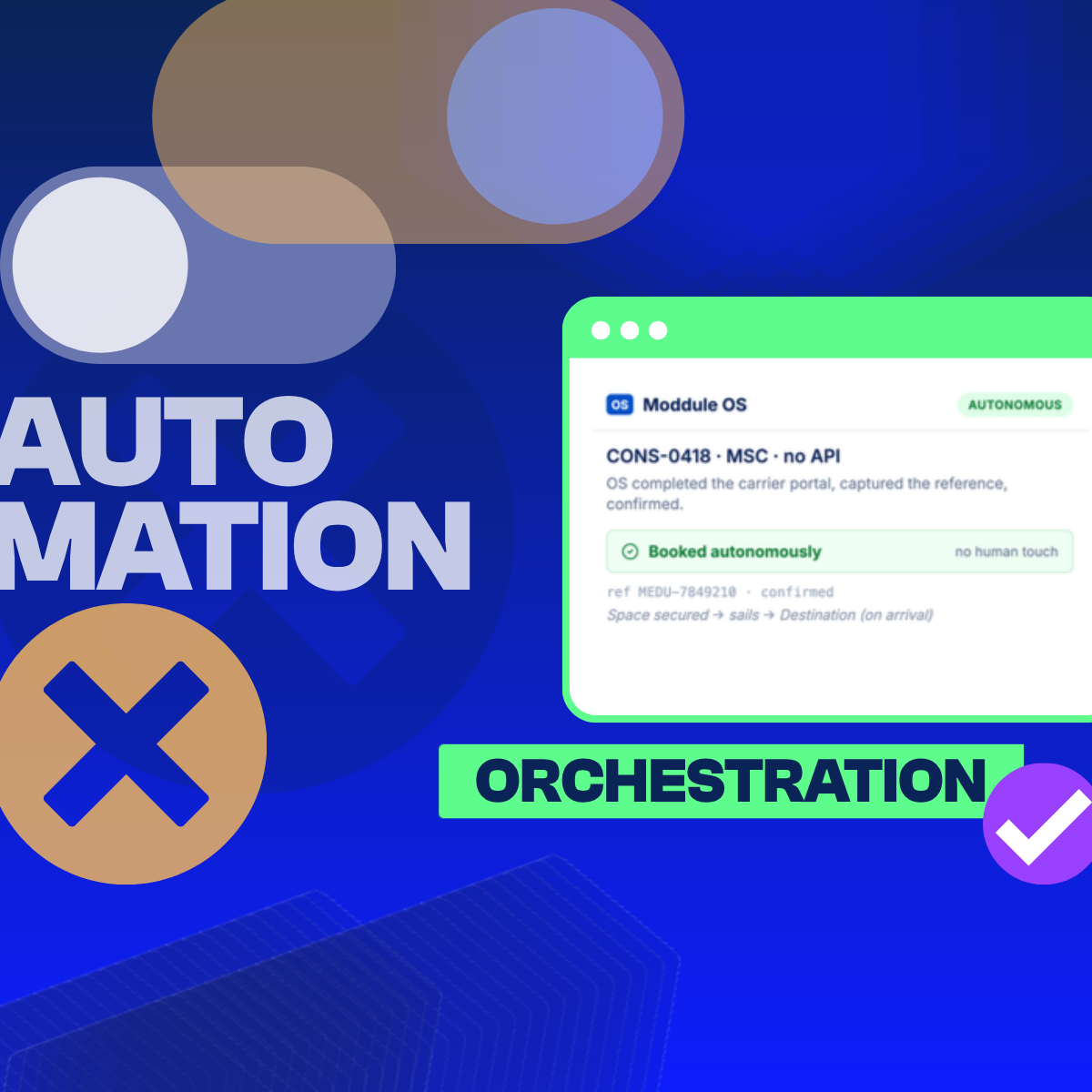
This is the big one. Most companies approach integration as a simple pipe: move data from point A to B. But data in logistics isn't static; it needs to trigger actions. True automation happens when you stop thinking about integrations and start thinking about workflow automation. It’s not just about getting the data into the system; it’s about the data moving seamlessly through every stage of the lifecycle without manual intervention.
Speeding forward
Automation is only as good as the data feeding it. At Splice, we’re obsessed with solving these connectivity hurdles so that platforms like Moddule can do what they do best: create an incredible data experience for your customers.
Don't let legacy logic kill your future-ready goals. It’s time to move past the "A to B" mindset and build automation throughout your supply chain – and leave Tetris in the game room.